So you’ve submitted your resume to what feels like a hundred companies. You’ve checked your email every morning hoping for a reply. Weeks pass. Nothing.
Sound familiar?
Here’s the truth nobody tells freshers — most of the time, it’s not your degree, your CGPA, or your lack of experience that’s holding you back. It’s a handful of very fixable mistakes that almost every fresher makes, usually without realizing it.
Let’s talk about each one honestly.
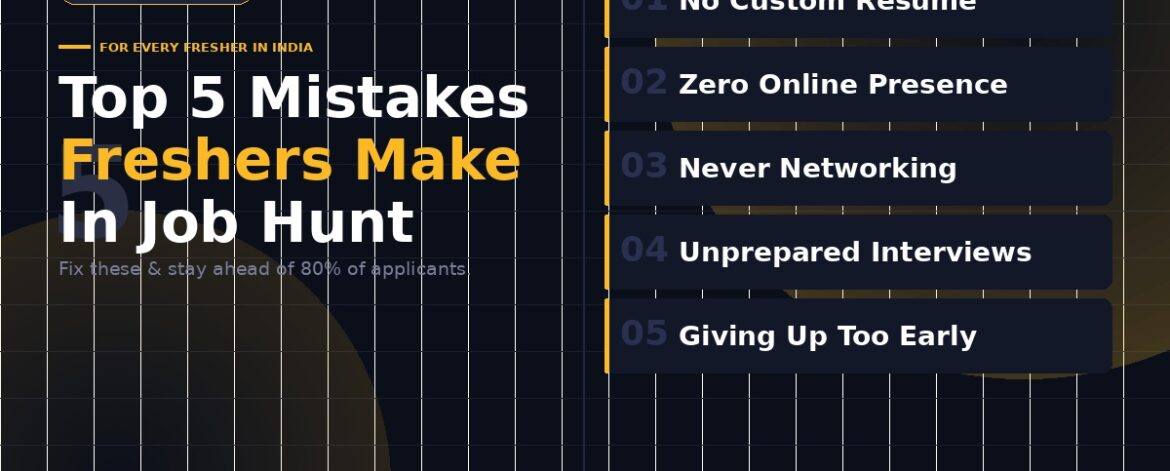
Mistake 1: Sending the Same Resume to Every Single Company
This is probably the most common one, and it silently kills more applications than anything else.
Most freshers create one resume and blast it to every opening they find. It feels efficient. It’s not.
Here’s why — almost every mid-to-large company today uses something called an ATS (Applicant Tracking System). This software scans your resume before any human ever sees it. It’s looking for specific keywords that match the job description. If your resume doesn’t have those keywords, it gets filtered out automatically. The recruiter never even knows you applied.
Tailoring doesn’t mean rewriting your entire resume for every application. It means spending 10 minutes reading the job description carefully and making sure the language in your resume reflects what they’re asking for. That’s it. Ten minutes that can completely change whether your application moves forward.
Mistake 2: Having No Online Presence (or an Empty LinkedIn Profile)
Before a recruiter picks up the phone to call you, there’s a good chance they’ve already Googled your name.
What do they find?
If your LinkedIn profile is empty, or you don’t have one at all, that’s a red flag — not because you’re doing anything wrong, but because it signals that you’re not serious about your career yet. In 2025, your LinkedIn profile is your digital first impression. It’s often more important than your resume.
Fill in your headline, add a proper profile photo (not a cropped group photo), write a short summary about yourself, list your projects and internships, and ask a professor or senior to give you a recommendation. It takes a few hours to set up properly. But once it’s done, it works for you quietly in the background every single day.
Mistake 3: Only Applying Online and Never Actually Networking
Here’s a statistic that surprises most freshers — nearly 70% of jobs are never publicly posted. They’re filled through referrals, internal hiring, and word of mouth long before they ever reach a job portal.
This means that if you’re only applying on Naukri, LinkedIn and company websites, you’re only seeing about 30% of what’s actually available.
The fix is uncomfortable but simple — talk to people. Reach out to seniors from your college who are working in companies you’re interested in. Connect with HR professionals on LinkedIn with a genuine message, not a copy-paste template. Attend virtual events, webinars and career fairs. Join communities in your field.
One real conversation with the right person can open a door that no amount of online applications will. Not because of favouritism, but because people genuinely prefer to refer someone they’ve actually interacted with.
Mistake 4: Walking Into Interviews Without Preparing
Be honest — how many of you have Googled “common interview questions” the night before an interview and called that preparation?
Most freshers do. And most interviewers can tell.
“Tell me about yourself” should not catch you off guard. Neither should “Why do you want to work here?” or “Where do you see yourself in five years?” These are predictable questions. They deserve prepared, thoughtful answers — not improvised ones.
Beyond the standard questions, spend time actually researching the company. What do they do? Who are their clients? What’s their culture like? Did they launch a new product recently? Knowing this shows genuine interest, and genuine interest is rare enough to be noticeable.
Give yourself at least five hours of preparation before a significant interview. Practise your answers out loud — not just in your head. The difference in your confidence will be very real.
Mistake 5: Giving Up After a Few Rejections
This one might be the most important.
The average job search for a fresher in India takes anywhere between three to six months. That involves dozens of applications, several rejections, a few ghostings, and a lot of waiting. That’s just the reality of the process — it has nothing to do with how good you are.
But most freshers quit long before that. They send out ten applications, hear nothing back, and convince themselves the market is impossible or that they’re not good enough. Neither is usually true.
Rejection is not feedback unless the recruiter tells you why. More often than not, it’s just timing, volume, or a slightly stronger profile on that particular day. It says very little about your overall potential.
Stay consistent. Keep improving your resume. Keep learning. Keep networking. The people who land jobs aren’t always the most qualified — they’re often just the ones who didn’t stop.
The Honest Summary
The job market is competitive — but a large part of your competition is also making these exact five mistakes. Fix your resume approach, build your online presence, start having real conversations, prepare properly for interviews, and commit to the process for longer than feels comfortable.
Do those five things consistently, and you’re already ahead of the majority.
If this helped you, share it with a friend who’s job hunting right now. And if you’ve made any of these mistakes yourself, drop a comment — you’re definitely not alone.
Follow NextStepHub for daily fresher job updates, interview prep guides and career tips that actually make sense.
🌐 nextstephub – Link